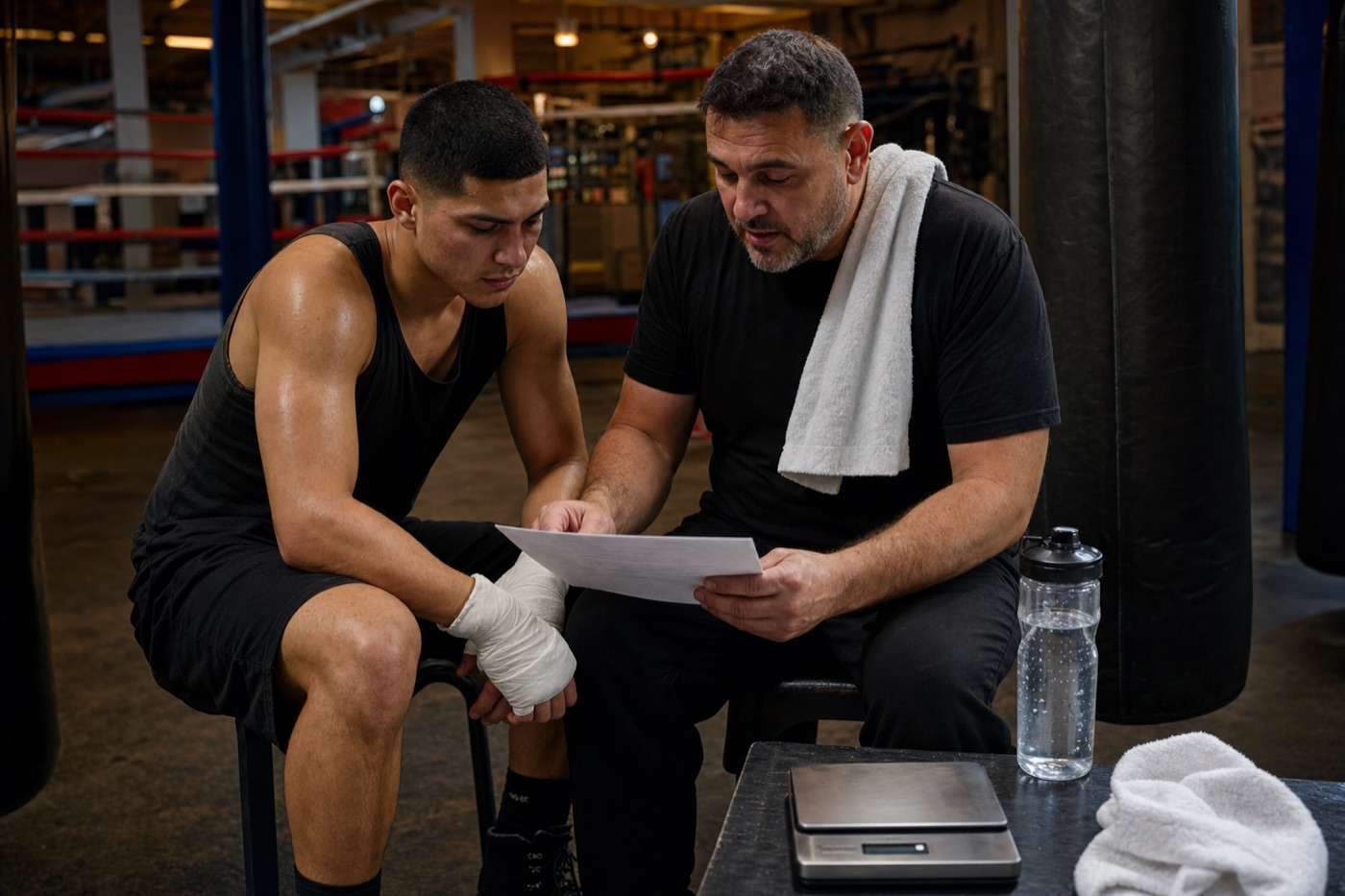
Boxing has weight classes, and fighters often try to arrive at a weigh-in at a specific number. That makes weight management part of the sport. It also creates pressure to lose water quickly, especially when the weigh-in is close to the bout. A sauna suit may appear in that conversation, but it should never be treated like a harmless shortcut.
Two different ideas get called “cutting weight”
The first is gradual weight management: building a realistic body composition, eating enough to train, and arriving near a class over weeks or months. The second is acute weight cutting: trying to move the scale quickly before a weigh-in, often through dehydration.
Those are not the same thing. A sauna suit belongs, if anywhere, in a tightly supervised conversation about acute water loss, not as a general fat-loss garment.
What the sauna suit does
The suit can increase sweating by holding more heat around the body. That can produce a fast drop on the scale. The drop is mostly water, and the fighter must then rehydrate and recover. The World Boxing Council says the temporary measurement change after sweating is not permanent fat loss.
If the weigh-in is close to the fight, there may be very little time to replace fluids, electrolytes, carbohydrate, and normal energy. The result can be a fighter who makes weight but performs worse or takes more risk under pressure.
Why timing matters
Different boxing organizations and events use different weigh-in windows. Same-day weigh-ins leave less time to recover than a weigh-in the day before. That difference changes the risk calculation, which is one reason a generic internet protocol is not appropriate.
The International Society of Sports Nutrition describes active sweating, including exercise with a sauna suit or layered clothing, as one acute weight-loss method. It also makes clear that combat-sport weight cutting has health and performance tradeoffs that require sport-specific planning.
What a safer team looks like
A qualified coach, athletic trainer, sports-medicine professional, and registered sports dietitian can help a boxer determine an appropriate class, body-fat range, training weight, fueling plan, and hydration strategy. The goal is to reduce the need for a dramatic final push.
A boxer should also know the warning signs that mean stop: confusion, faintness, severe headache, vomiting, chest symptoms, unusual weakness, loss of coordination, inability to cool down, or very dark urine. Those are not signs of toughness. They are reasons to seek help.
The simple bottom line
A sauna suit may be used in some adult training environments, but a suit is not a nutrition plan and not a substitute for medical oversight. Children and teenagers should not use sauna suits for weight cutting. Nobody should be pressured by a coach or teammate to dehydrate rapidly.
For most recreational boxers, the safest use is not cutting at all: choose a class that matches your normal training weight, build conditioning gradually, and use the garment only if a qualified professional agrees it has a clear purpose.
Scale math and fight readiness are different scores
A boxing scale records total mass. It does not tell you whether the athlete has adequate blood volume, muscle glycogen, electrolytes, or mental sharpness. A fast water cut can move the first number while hurting the rest. That tradeoff becomes more severe when there is only a short window between weigh-in and competition.
This is why experienced teams talk about a normal training weight and a realistic class long before fight week. The less last-minute work required, the more time an athlete has to replace fluids, eat, sleep, and return to a normal training rhythm.
Questions a responsible team should answer
What is the weigh-in window? Who is monitoring the athlete? What is the plan if the athlete does not make weight? How will fluids, sodium, carbohydrate, and sleep be restored? What symptoms mean the session stops immediately? If the answer to any of those questions is “we will figure it out in the sauna,” the plan is not ready.
The practical role of sauna wear, if it appears at all, should be narrow and supervised. For recreational boxers, the simplest and safest choice is usually to compete near a body weight that does not require acute dehydration.
Takeaway: Sauna suits remove fluid, not fat. Rapid dehydration can reduce performance and create serious health risks. Weight management should happen over time with a qualified team, not as a last-minute solo experiment.